From Vibe Coding to Spec-Driven Development: The Power of a Great Spec
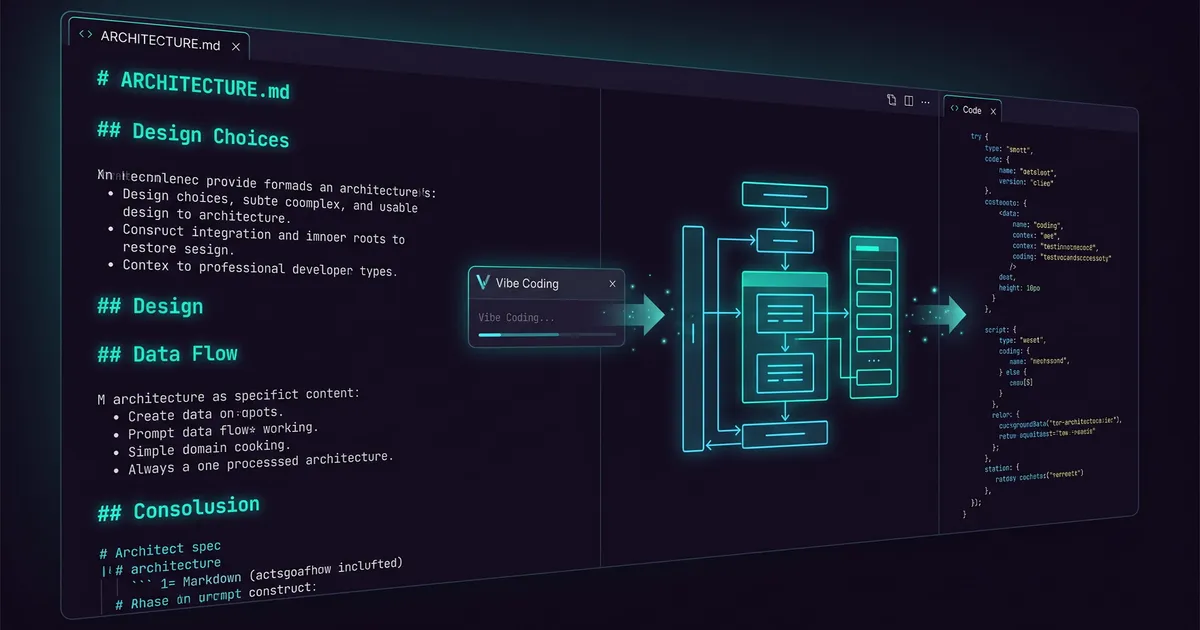
The Shift in AI-Assisted Development
When autonomous AI coding assistants arrived, many developers quickly adopted a highly conversational workflow often called vibe coding: describe a feature in natural language, review the generated output, and iterate based on what you see.
For exploration, prototypes, and small experiments, this can be remarkably effective. A prompt such as “Build me a login page” can produce a useful starting point in seconds.
The challenge begins when the same free-form workflow becomes the primary way to build a production system. Vague prompts leave important decisions unresolved, so the model fills in the gaps on its own: choosing libraries, inventing patterns, interpreting security requirements, and making assumptions about data flows. Across many features and many iterations, those local decisions can drift into an inconsistent architecture.
That is not an argument against AI coding. It is an argument for giving AI better constraints.
This is where Spec-Driven Development (SDD) becomes valuable.
From Prompting to Context Engineering
Spec-Driven Development shifts the center of gravity from code to intent. Before implementation begins, the team writes a structured specification that describes the problem, the boundaries, the technical choices, and the expected behavior.
Code remains important, of course—but it becomes the implementation of a clearer plan rather than the place where the plan is discovered by accident.
At the most formal end of the spectrum, teams may use requirements languages such as EARS (Easy Approach to Requirements Syntax) or multi-agent workflows that separate planning, implementation, and verification. Those approaches can be useful, especially in large or regulated environments.
But a great result does not require an elaborate framework. In many projects, a thoughtful, human-readable Markdown document is enough to establish the context an AI agent needs before it writes a line of code.
The Anatomy of a Great Markdown Spec
Give an AI agent a structured file such as ARCHITECTURE.md, and it has less reason to guess. The time invested in the blueprint lets you choose the tools, constraints, and conventions that fit the application—before implementation momentum makes those choices expensive to change.
A useful specification typically includes:
User stories and requirements
What users need to accomplish, the acceptance criteria, and the boundaries of the feature.Background and motivation
Why the feature exists, the problem it solves, and the decisions that shaped its design.Technical stack and approved tools
The framework, libraries, database drivers, ORM, and other dependencies the project should use.Data models and schema
Entities, fields, relationships, constraints, migrations, and ownership of data.Architectural decisions
Authentication and authorization rules, middleware placement, API conventions, error handling, validation, and mutation flows.Non-functional requirements
Performance expectations, security requirements, accessibility, observability, testing, and deployment constraints.
The goal is not to eliminate engineering judgment. It is to direct that judgment deliberately.
When the specification provides enough context, the agent can spend less effort inventing assumptions and more effort implementing the intended design. The spec becomes a living contract: something developers and agents can use to plan, build, review, and verify changes.
Specs Should Be Living Documents
A specification is not valuable because it is written once. It is valuable because it stays connected to the system.
As requirements evolve, update the spec. As architectural decisions change, record why. When a new engineer or AI agent joins the work, the document should explain not only what the system does, but also why it is structured that way.
This makes a Markdown spec more than documentation. It becomes durable project context—version-controlled, reviewable, and reusable across tasks.
Vibe Coding Still Has a Place
Vibe coding is excellent for discovery. It helps us test ideas, sketch interfaces, explore alternatives, and turn ambiguity into something concrete.
The practical workflow is not “vibe coding versus specifications.” It is often:
- Explore quickly.
- Turn what you learned into a clear specification.
- Build the production version against that specification.
- Use the spec to review and verify future changes.
That sequence preserves the speed of AI-assisted exploration while reducing architectural drift as the product grows.
The Real Opportunity
AI frees engineers from some of the repetitive work of writing code. The higher-value work is deciding what should be built, which constraints matter, how the pieces fit together, and how the system will remain reliable as it changes.
A great specification gives that thinking a concrete form.
The better the context we provide, the more consistently AI can help us build software that is not only fast to generate, but also secure, understandable, and maintainable.